

Share:


Key Takeaways
- Senior care spends too must time on product and functional-benefits messaging and not enough time on emotional and core-value messaging.
- Payers and providers must show up for consumers in a more human way that proves their advocacy and earns back trust.
- Trust in healthcare is on the brink, which is why it needs to be a key performance indicator moving forward.
How long have I seen senior care strive to be centered on consumers? Years? Decades? The truth is that, too often, consumers don’t see or trust this aim. Marketing can take part of the blame. I’ll explain why shortly.
After years of working in senior care, I’ve discovered that the way out is through messaging that speaks for seniors, not just to them. Why? Because seniors don’t want just to be considered—they want to be reassured, cared for, and advocated for. The brands that prove they can be there for seniors and that they can be trusted are the ones that will win in a system increasingly defined by complexity and skepticism.
Why current senior-care marketing fails the trust test
I’ve seen too many senior-care companies get stuck on the bottom rungs of the benefits ladder on product features and functional benefits. The ubiquitous $0 premium or copay ads come to mind. Yes, no-cost premiums and copays make accessing coverage and care affordable, but they don’t do anything to inspire a real emotional connection or foster a consumer’s deepest values.
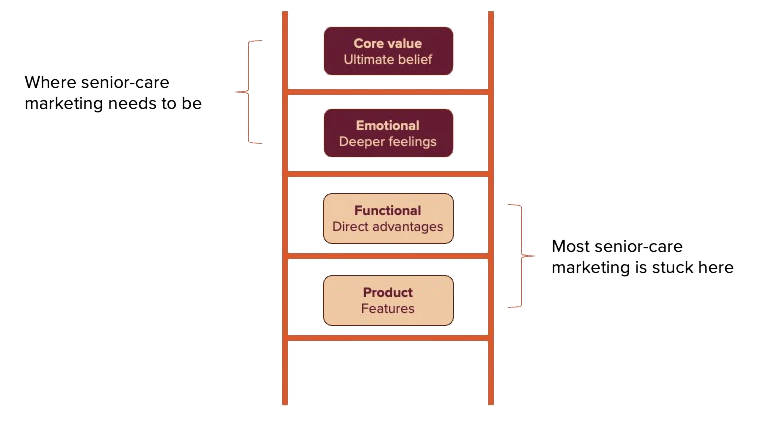
The Centers for Medicare & Medicaid Services have rightfully added more marketing compliance guardrails to protect Medicare beneficiaries from bad actors and deceptive promises. I’ve seen too many legal and compliance teams play it too safe with intentionally neutral and informational messaging. Facts and figures get prime billing and disclaimers run amok. As a result, marketing feels distant, disconnected, and impersonal.
But consumers aren’t just looking for information. They also need reassurance.
In senior care, the stakes are high, but the humanity is low
Healthcare decisions can be high stakes and emotionally loaded. I hear seniors ask these kinds of questions all the time: Should I make the tradeoff to pay more out of pocket each month or gamble on the $0 premium and try to stay healthy all year? Should I take a chance on this new care team who is promising a lot? Should I have this risky surgery?
Too often, senior-care marketing doesn’t reckon with seniors’ feelings of overwhelm, confusion, frustration, and fear. Instead, it responds with more information—more plan options, more benefit descriptions (and disclaimers), more service-explainer videos, more emails and letters.
People aren’t wired for that. They’re wired for connection. In our work, seniors have told us this repeatedly. They don’t talk about features or benefits, but they do talk about being treated with dignity and respect. As one Medicare beneficiary put it about his plan and provider, “They treat me like a human being. They tell it to me just like it is. I’m 75 years old and never had that before.”
We’ve learned that seniors want:
- To feel like they’re making the right choice.
- Their plan and providers stop showing up in legal and compliance mode and start showing up in compassionate human mode.
- Their carrier and providers show up with authenticity and empathy.
- To hear things like, “If I were in your shoes, here’s what I’d do” or “Here’s how I’m going to help you.”
- To know that senior-care organizations have their backs and can be trusted.
Here are a few very basic ways senior-care companies can show up in a more human way:
- “We understand what you’re up against.”
- “We’ll help you navigate this.”
- “You’re not on your own.”
The path to earning seniors’ trust is long, and marketing is just the first step. It can be reinforced or lost with every interaction. That’s why being a senior advocate can’t only be a marketing shift—it also needs to be an organizational shift.
Why consumer trust needs to be a KPI
In business, what matters gets measured. Trust needs to be a key metric for your marketing campaigns and your organization as a whole. It’s arguably one of the biggest challenges the healthcare industry faces, especially for insurers.
According to Forrester’s, only 25% of noncustomers and 54% of customers describe health carriers as trustworthy. Low-trust customers who can switch plans are 10 times more likely to do so than high-trust customers. Health insurers deliver the weakest total experience of all industries Forrester tracks.
High-trust consumers report greater ease and effectiveness and a higher incidence of positive emotions. Between ease, effectiveness, and emotion, emotion is the most important one. Yet most healthcare leaders are focused on improving digital experiences.
Better digital experiences can only move the needle so much. What will truly make a difference is acting as a dedicated partner in seniors’ health by first listening to and then advocating for them.
SCAN Health disrupted the 2026 Annual Election Period by naming consumers’ frustrations. That’s a great start, but it doesn’t take the advocacy leap. Imagine seeing a senior marketing campaign concepted around “we listened, and here’s what we’re changing” or “here’s how we’re solving these problems.” That type of campaign doesn’t just earn attention—it earns trust. Trust drives confidence, growth, and loyalty.
Like what you read? We’ve got more here.